
Federal BOP Release Paths
A completed federal prison term can return a person to the community, often with a period of supervised release imposed by the federal judgment. It can also lead to another custodian when a state case, local warrant, immigration matter, or other lawful hold remains. “Released” in the BOP system describes BOP custody. It does not mean that every other authority has ended.
The county connection can occur before the federal prison term. The Klamath County Jail accepts some state and federal prisoners, and a local detail page may close with TRANSPORT. That event proves departure from the Klamath booking, not release into the community. U.S. Marshals movement, the federal docket, and later BOP records establish the next stages.
| Record | What it can establish | What it cannot establish alone |
|---|---|---|
| KCSO released booking | The local jail interval closed. | That federal custody or all detention ended. |
| BOP locator result | BOP status and a listed release date. | No supervision, state hold, or new custody. |
| Federal docket | Release or detention orders and judgment terms. | The exact corrections movement without an agency record. |
| Agency record | Official custody, movement, or release documentation. | Unrelated county or state case outcomes. |
No Klamath County BOP Prison
No Federal Bureau of Prisons institution was identified in Klamath County. A federal case arising in or near the county does not place the defendant in a local BOP prison. Pretrial custody may involve the U.S. Marshals Service and contract or intergovernmental beds. Sentenced imprisonment may occur at a BOP facility elsewhere in the nation.
KCSO's statement that it accepts prisoners from various federal agencies establishes only that a federal agency may use the county jail. It does not create a BOP institution at the Vandenberg Road jail. The local sheriff can supply the booking and transfer record. BOP supplies sentenced federal prison status, and the U.S. District Court docket supplies the detention order and judgment.
Note: A Klamath federal case can lead to a BOP institution elsewhere without creating a federal prison inside the county.
Confirm Federal BOP Release Records
Use the BOP Inmate Locator for someone who served a federal sentence. An identifier is the most precise search. The system accepts a BOP Register Number, DCDC Number, FBI Number, or INS Number. A name search can be narrowed with age, race, and sex. Compare the result carefully because common names can return more than one person.
- Choose the identifier search when a federal number is known; otherwise use the name fields.
- Compare all displayed identity details before opening or relying on the match.
- Read the release status and date exactly as displayed, including “Released” or “Not in BOP custody.”
- Check the federal docket for the judgment, detention order, and supervised-release term.
- Check the receiving agency if a hold or transfer may have followed BOP custody.
The official locator is the matching federal release-search source.
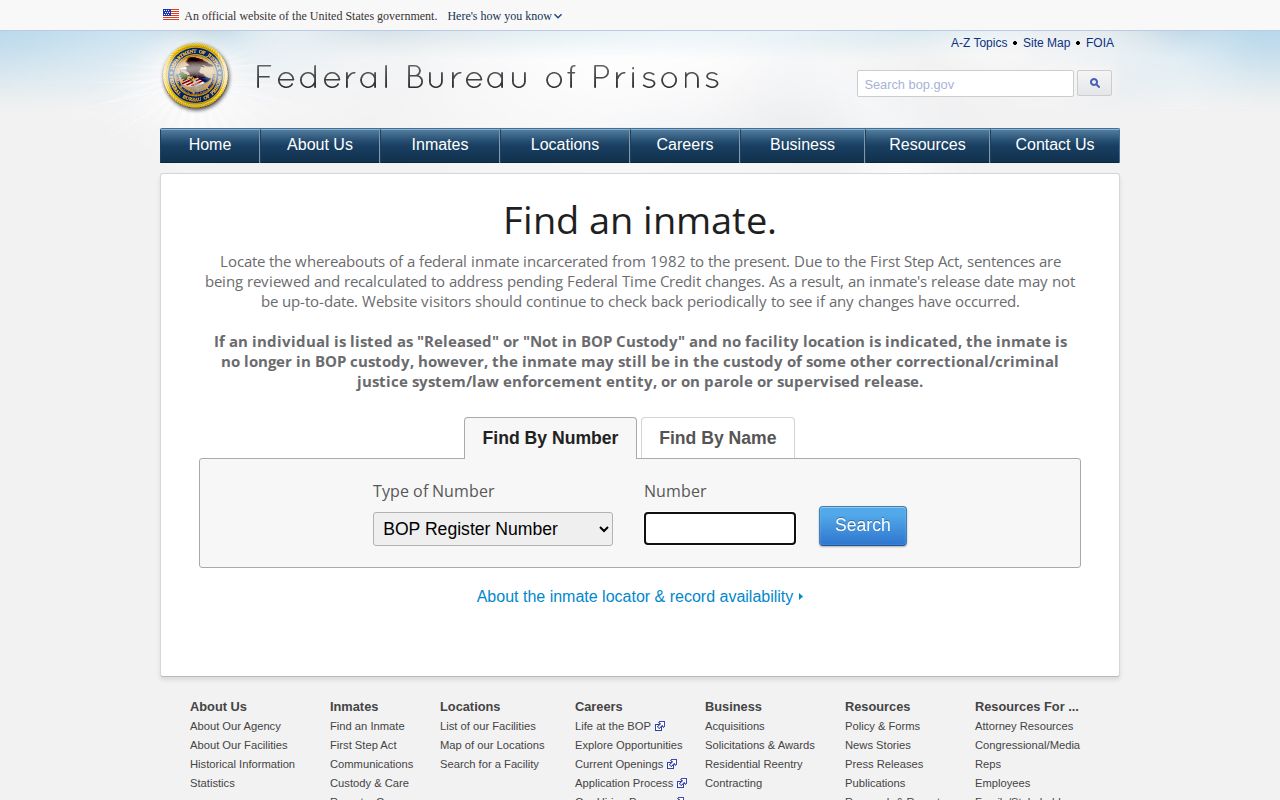
BOP's locator generally covers federal inmates from 1982 onward. Older history or a result that lacks the needed detail calls for a federal agency record. A no-result can reflect a name mismatch, date scope, or a person who was never committed to BOP.
Search identifiers should be preserved exactly. A BOP Register Number is not interchangeable with a KCSO booking number, Oregon SID, or ICE A-number. When the only known reference comes from the local jail, use the federal docket to connect the county booking to the federal case and obtain the correct federal identifier. That avoids attaching one person's release result to a namesake.
Read Federal BOP Release Status
A former prisoner result may display “Released” with a date. BOP explanatory text may instead say the person is not in BOP custody. Both phrases are specific to BOP. They do not state that federal supervised release ended. Supervised release is a court-ordered community term administered through the federal system, distinct from Klamath County probation or Oregon post-prison supervision.
The date is also not a full movement history. A person could have left one BOP facility through transfer, community placement, hospital movement, or handoff before the final status shown. If the precise exit route matters, ask for the responsible agency record and compare it with the docket. Do not infer present location from an old facility name.
- BOP custody
- Federal sentenced imprisonment administered by the Bureau of Prisons.
- Supervised release
- A separate federal court-ordered community term that can continue after prison.
- USMS custody
- Federal pretrial detention and movement administered by the U.S. Marshals Service.
- Detainer
- A basis for another authority to seek custody when one system releases the person.
Klamath Federal Transfer Release Records
Klamath County's viewer contains a public example of a U.S. Marshals-related booking with a TRANSPORT clearance. That interface behavior is useful because it demonstrates the exact risk of stopping at the word “RELEASED.” The booking ended at Klamath County Jail. The clearance directed the search into the federal system.
For the local interval, preserve the KCSO booking number, released heading, Release Date, case fields, and every Clearance. A formal request to the KCSO Records Unit can seek the releasable booking sheet, actual transfer date and time, release or clearance reason, and destination agency. The federal docket or agency record then documents what happened beyond the county handoff.
The Klamath County Jail release record page explains how to interpret the local viewer and file that focused county request. It should be used only for the jail interval, not as a substitute for BOP status.
Federal Court Release Records
PACER or the responsible U.S. District Court docket is the source for the federal case history. Read the detention or release order, judgment, sentence, and later supervised-release proceedings. A docket event and a physical custody event can occur at different times, so compare the court record with BOP or USMS documentation.
A federal judgment can state the prison term and supervised-release term. It does not necessarily identify every later institution, transport time, or other-jurisdiction hold. Likewise, a BOP locator release date does not explain the legal basis for the sentence. The two records answer related but distinct questions.
Later docket entries may address an alleged violation, modification, or revocation of supervised release. Those events can return a person to custody after the original prison release date. Read the filing date, order, and outcome instead of assuming the oldest release result describes present status. Current local or state custody still requires the relevant local jail or state corrections source.
Note: Use the court docket for legal orders and the custodian's record for actual movement or release confirmation.
Federal BOP Release Contact Route
The research supplies an official BOP locator but no verified Klamath BOP facility address or local BOP phone because no such institution was identified. The contact route depends on the record needed. Use BOP for sentenced federal prison information, USMS for applicable pretrial custody or movement, the federal court for docket documents, and KCSO only for a local jail interval.
Federal Bureau of PrisonsNationwide sentenced-prison system
Public status: BOP Inmate Locator
No BOP institution identified in Klamath County KCSO Records Unit
3300 Vandenberg Road
Klamath Falls, OR 97603
541-883-5130, option 3
Local booking and transfer records only
A narrow request should name the person, number, date range, facility or agency, and exact record. Ask for a release or movement document rather than an undefined “full file.” Each agency can respond only for records it controls.
For the Klamath record, the KCSO request can seek the releasable booking sheet, actual release or transfer date and time, clearance reason, and destination agency. The sheriff's published process may involve fees and exemptions. For the federal segment, use the records process of the actual custodian and ask whether certification is available if formal proof is needed. Keeping the two requests separate makes each response easier to interpret.
Federal BOP Release System Scope
The BOP locator is a durable federal prison route, not a universal custody search. It does not replace ICE's current detention locator, the Oregon DOC offender search, or the Klamath County Jail viewer. A federal defendant held by USMS before sentence may have no BOP release entry for that pretrial period. An immigration transfer requires a separate ICE check.
The reliable chain starts with the last known custodian and follows each transfer. County jail data proves the county interval. Federal court data proves orders and judgment. BOP data proves sentenced federal prison status and the listed release. Other agencies confirm any later hold. The Klamath County released-inmate search helps identify which custody system should lead without merging their distinct meanings.
Note: A BOP release result is federal-prison evidence, not a universal statement about every later custody or supervision system.