
Oregon DOC Release Destinations
An Oregon DOC institutional release may lead to post-prison supervision, parole in a Board-authority case, short-term transitional leave, full discharge, or a handoff to another custodian. Post-prison supervision follows many modern determinate prison terms. Parole is a supervised release status used for cases within Oregon Board of Parole and Post-Prison Supervision authority. Discharge means the relevant correctional authority has ended. These labels should be kept distinct.
A detainer can redirect the person to another jurisdiction on the date ODOC custody changes. Short-Term Transitional Leave can place an eligible person outside the institution under legal custody and conditions before the discharge date. Neither event proves an unrestricted return to Klamath County. Confirm both the departure from the Oregon institution and the destination or supervision status.
| ODOC event | What it supports | Next source |
|---|---|---|
| Institution to supervision | Physical prison custody ended; legal supervision continues. | OOS, VISOR, Klamath Community Corrections. |
| Discharge | ODOC authority may have ended as shown in the official record. | ODOC record and sentencing court. |
| STTL | Community placement under legal custody and conditions. | ODOC status and approved release plan. |
| Detainer transfer | One custody interval ended through a handoff. | Receiving agency and official movement record. |
Note: Confirm both departure from an ODOC institution and the person's destination before describing a Klamath County community release.
Klamath County Has No ODOC Prison
The official ODOC institution directory identifies 12 institutions, and none is in Klamath County. Warner Creek Correctional Facility is in Lake County and must not be described as a Klamath facility. A conviction in Klamath Circuit Court does not determine the institution. ODOC classification and movement processes control placement, and the institution can change during a sentence.
This absence shapes the search. A Klamath County Jail booking with a DOC clearance can mean the local booking ended because ODOC received the person elsewhere. It does not mean the person was released to the community. The county record documents the jail interval; statewide ODOC sources document prison custody, release calculation, and later supervision.
Confirm Oregon DOC Release Status
Oregon Offender Search, or OOS, is the public starting point. Search by name or state identifier when known. Compare identity fields, then read status together with the institution or supervision location. A person listed under supervision has left prison but has not necessarily finished the sentence. A released or discharged label concerns ODOC custody or authority and does not resolve every county court matter.
- Open OOS through the official ODOC gateway and search by name or state identifier.
- Match the person carefully and read the displayed status, location, sentence, and date labels together.
- Check Oregon VISOR for current custody or supervision information and available alerts.
- Contact Klamath County Community Corrections if the record points to local supervision.
- Request an official ODOC record when the result must document release, discharge, movement, or sentence history.
The OOS search workflow shows the statewide criteria and result route.
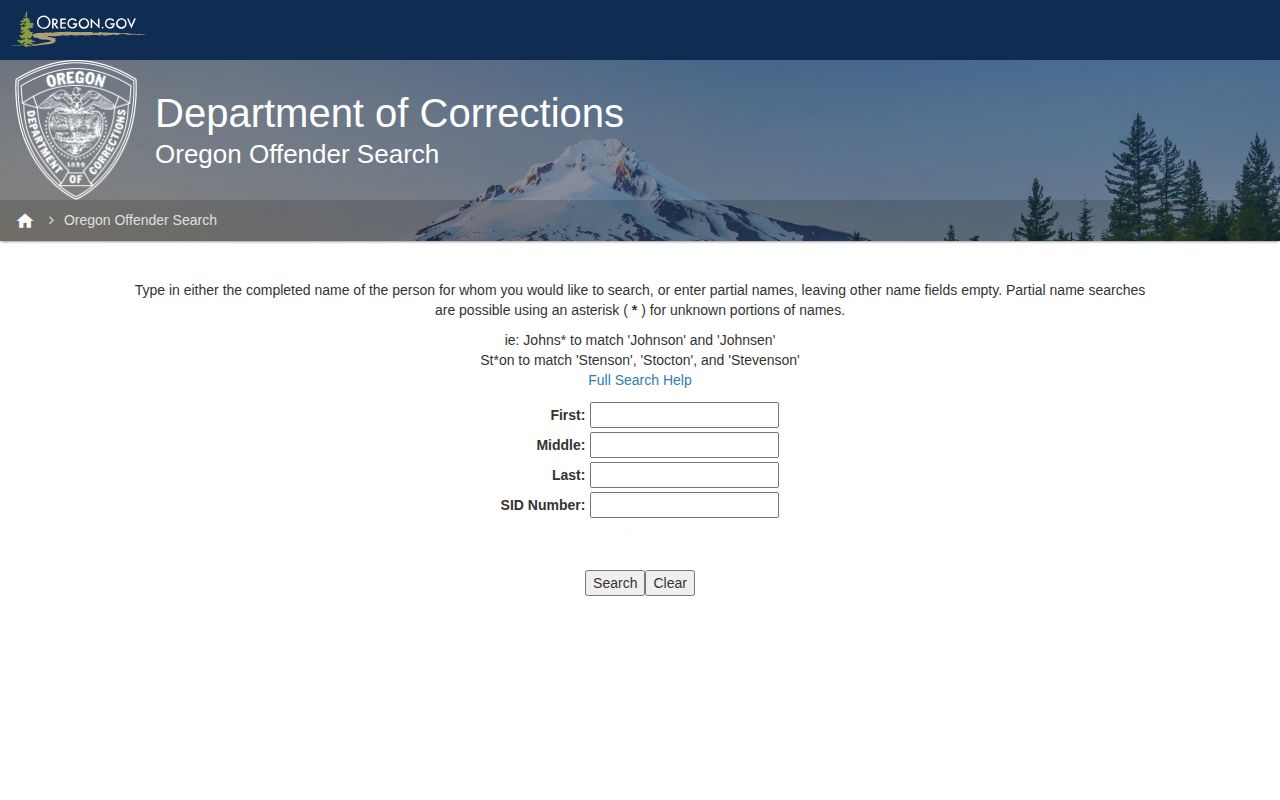
The interface is a locator and lead. ODOC expressly says an official or certified offender record requires a public-record request. A no-result is also not proof of a recent release because a fully discharged person may no longer fall within a live custody or supervision scope.
| OOS information | How to read it |
|---|---|
| SID and identity data | Use them to separate people with similar names. |
| Status | Read it with the institution or supervision location. |
| Admission or sentence data | Compare it with the Klamath judgment. |
| Projected or earliest date | Treat the live label as a forecast, not an actual release. |
Oregon DOC Release Date Fields
ODOC guidance calls its calculated date a projected release date and says that date is available through OOS. Records have also used an “Earliest Release Date” label. Preserve the live label rather than converting it to a term used by another system. A projected or earliest date is a calculation, not proof that the person crossed the prison gate.
The calculation begins with the court judgment, offense date, term length, concurrent or consecutive structure, jail credit, and eligibility findings. Earned time can alter a qualifying term. Board action, an amended judgment, recalculation, lost or restored credit, a new sentence, escape time, or a detainer may change the displayed date or what happens on it. Oregon does not have a general 85 percent rule. Under ORS 421.121, eligible terms may receive up to 20 percent earned-time reduction, while Measure 11 mandatory minimums under ORS 137.700 generally bar that reduction during the minimum.
Note: Never apply a simple percentage to a Klamath judgment and present the result as an official Oregon DOC release date.
Oregon DOC Release Record Requests
For documentary proof, use the ODOC Public Records Center. Identify the person by full name and SID, include the Klamath judgment or case number when known, and state the exact dates and records sought. Ask whether a public Pen Pack can provide public-information prints, first and last face sheets, a photograph, court or sentence orders, and available parole discharge or sanction records.
Oregon DOC Public Records Request3723 Fairview Industrial Drive SE, Suite 200
Salem, OR 97310
Former Offender Records/OISC routing: 503-570-6919
Online requests use ODOC GovQA
Published ODOC rates are $25 per clerical hour, $40 per managerial hour, and $75 per professional hour, plus applicable copy, media, and postage costs. ODOC may clarify scope, provide an estimate, and wait for payment. Listed payment types include money order, cashier's check, and business check, not personal checks. A narrow record and date description can reduce search time.
The official records page illustrates the GovQA and Pen Pack route.
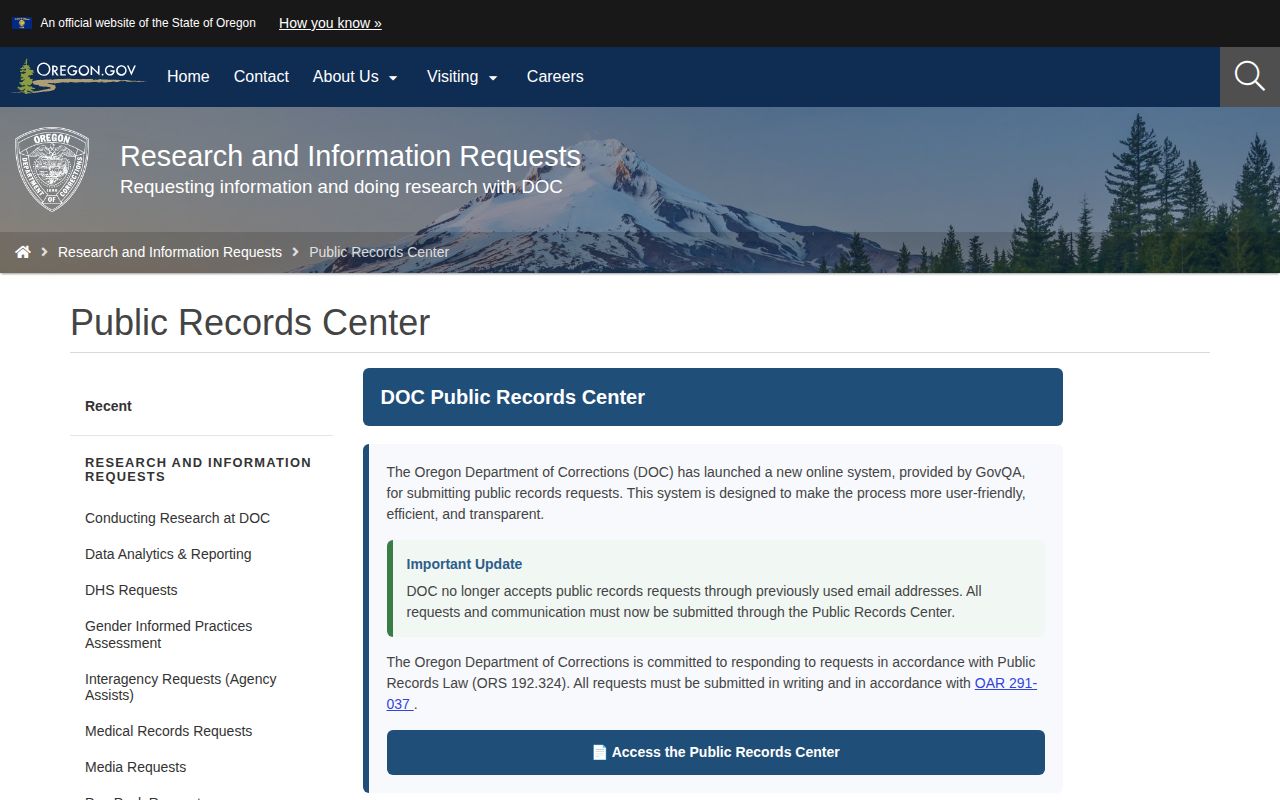
The resulting ODOC record can establish more than the public locator, but the sentencing court remains the source for the controlling judgment and later amendments.
Note: Ask ODOC for certification in the request when an ordinary locator result will not meet the need for formal proof.
Klamath ODOC Release Supervision
Klamath County Community Corrections is the local Adult Probation and Parole Department. It can help confirm public information when OOS or VISOR shows supervision but does not reveal enough detail. The main office is at 3203 Vandenberg Road, Klamath Falls, OR 97603, and its phone is 541-880-5500. Hours are Monday through Thursday from 8:00 to 11:30 a.m. and 1:00 to 5:00 p.m., and Friday from 8:00 to 11:30 a.m.
The department serves areas beyond Klamath Falls, including Chiloquin and Two Rivers, Gilchrist and Walker Range, East County, North County, and Keno. A regional assignment can therefore be correct even when the main public office is in the county seat. Ask whether public information confirms active probation, parole, or post-prison supervision and which office handles it. Protected treatment, victim, medical, and case-management details are not part of that request.
A supervision record confirms community status subject to conditions. It does not prove that every court case has ended or that the person has discharged all authority. The Klamath County Probation & Parole page distinguishes those statuses and the local verification path.
The Oregon Board of Parole and Post-Prison Supervision is separate from the county field office. It sets, affirms, defers, postpones, or otherwise acts on dates and conditions only in cases assigned to its authority. Most modern determinate sentences move to post-prison supervision without an ordinary discretionary parole-release hearing. A Board calendar entry is a scheduled event, and a final Board order is a decision; neither alone proves the date of physical departure from an ODOC institution.
Oregon DOC Release System Scope
ODOC institutions hold people sentenced to the state prison system. They are not county jails, and the statewide locator does not replace a KCSO record for a local pretrial or short county-jail stay. In the other direction, the county viewer cannot prove an actual ODOC prison release. Each source documents its own custody interval.
The state path has several layers. OOS provides public offender information and the projected date field. VISOR can show current custody or supervision and send selected notifications. GovQA produces releasable official records. The Oregon Board handles release-date or supervision actions only in cases within its authority. Klamath Community Corrections provides local field supervision, while the sentencing court supplies the judgment and disposition.
When those sources disagree, preserve each result and its date. A live portal can update after an official document was created, while a court judgment may later be amended. Ask the source responsible for the disputed field to explain or correct its own record. ODOC cannot rewrite a court judgment through an informal message, and a court clerk cannot certify a later prison movement that belongs to ODOC.
- Post-prison supervision
- Community supervision that follows many modern determinate Oregon prison sentences.
- Parole
- Release under Board authority for a parole-eligible sentence.
- Detainer
- A legal basis for another authority to take custody when ODOC releases or transfers the person.
- Pen Pack
- An ODOC records package that may contain face sheets, public prints, a photo, judgments, and discharge material.
For a Klamath County name that moved between systems, the released-inmate record search links the county booking, Klamath Circuit Court case, state corrections record, supervision status, and any federal handoff without treating one database as universal.