
Klamath Projected Versus Actual Release
A projected release date is a calculated future date. It reflects the sentence and the correctional rules known when the agency runs the calculation. Oregon Department of Corrections calls the field a projected release date in current guidance. VISOR's individual record template uses “Earliest Release Date.” Use the exact label on the live record. Neither label establishes an actual exit time.
Actual release is an event. It can mean a person left Klamath County Jail, departed an ODOC institution, entered Short-Term Transitional Leave, moved to supervision, or transferred to another custodian. Each outcome has a different record. A release from one facility is not always freedom in the community. The booking clearance, receiving agency, and supervision status resolve that distinction.
The court and corrections agency also answer different parts of the question. The judgment states the lawful sentence. KCSO or ODOC calculates and records the custody date under that judgment. VISOR can send an event alert, but it does not replace either source. When the date matters, keep the judgment, live corrections result, and final release or transfer record together.
A pretrial detainee generally lacks a sentence-based date. The court may authorize security release, recognizance, or conditions, yet another hold or ordinary processing can delay departure. A sentenced person has a judgment that supplies the term and structure for calculation. The jail or ODOC then applies valid credit and correctional rules.
Find Klamath Projected Release Dates
Start with the last known custody system. Klamath County Jail holds local pretrial detainees and some county-sentenced people. ODOC holds people committed to state prison, often outside Klamath County. Federal and immigration custody require federal sources. Searching the wrong system can make a valid record look absent.
- Check the KCSO Web Jail Viewer for the local booking, actual Released field, Sch Rel Date, and each charge's Clearance.
- For an Oregon prison sentence, search Oregon Offender Search by name or SID and open the matching record.
- Read the exact projected or earliest release label with the status, institution, and supervision fields.
- Compare the date with the sentencing court judgment, including consecutive or concurrent terms and credit for prior custody.
- Ask KCSO for a county sentence calculation or ODOC for an official correctional record when proof is required.
- Check the receiving agency whenever a clearance or detainer shows a transfer rather than community release.
The Oregon Offender Search criteria screen is the state starting point for a Klamath County person sentenced to ODOC.
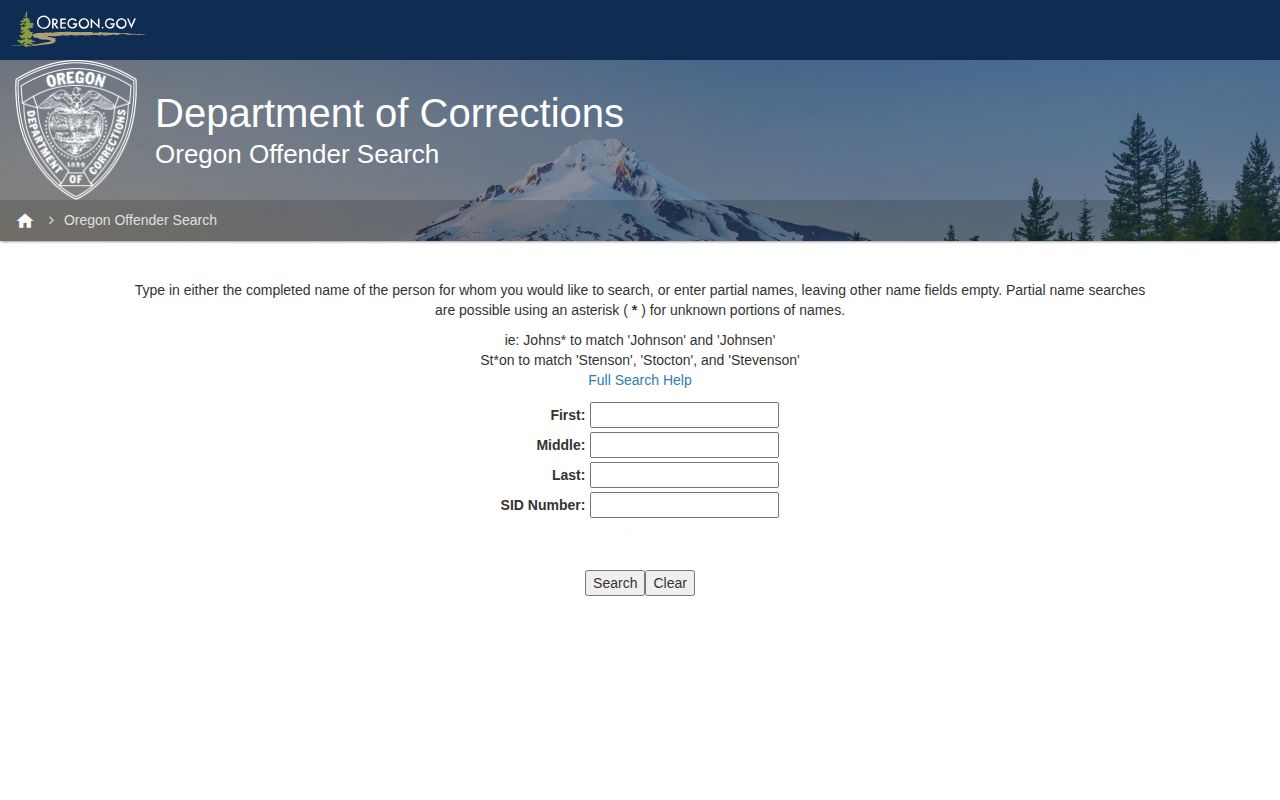
The state form serves ODOC records, while the KCSO viewer remains the correct source for the local jail interval. Broader county search paths and official record requests are covered on the Klamath County released inmates home page.
Note: OOS is a public locator and lead; ODOC directs requests for official or certified records to its Public Records Center.
Klamath ODOC Release Calculations
The calculation begins with the court judgment. Key inputs include the sentence length, the offense and offense date, consecutive or concurrent terms, credit for time already served, and any judicial finding that controls eligibility. Consecutive terms run one after another. Concurrent terms overlap. ODOC then applies the statutes and administrative rules that govern that sentence.
Earned time may reduce a qualifying Oregon prison term. It is credit tied to eligible status and conduct, not a gift or a date a reader can compute from one number. Board action can also set, affirm, defer, postpone, or rescind a parole date for cases within the Oregon Board of Parole and Post-Prison Supervision's authority. Most modern determinate sentences do not use an ordinary discretionary parole hearing.
County jail dates follow a separate route. The KCSO viewer has a Sch Rel Date field, and a charge detail can show an End Of Sentence Date. Research found no published Klamath County jail good-time formula or weekend release policy. Oregon's state-prison earned-time percentage must not be applied to a county booking. Ask KCSO for the jail calculation and compare it with the court judgment.
- Projected date
- A corrections calculation based on facts and law then in the record.
- Actual release
- The recorded event when one custodian ends physical custody.
- Detainer
- A request or authority that can cause another agency to take custody.
- Discharge
- The end of the correctional authority described by the sentence or supervision record.
Klamath Release Has No 85% Rule
Oregon does not have a general rule that every state prisoner serves 85 percent. Under ORS 421.121, a qualifying felony term for a crime committed on or after November 1, 1989 may receive up to a 20 percent earned-time reduction. The law ties credit to appropriate institutional behavior and adult basic-skills participation. It also states that credit cannot cut actual ODOC confinement below six months.
Even the 20 percent figure is not a universal formula. A person may be ineligible, may earn less than the maximum, may lose and later restore credit, or may have several terms governed by different rules. The statute lists exclusions. They include terms under ORS 137.635, 137.700, 137.707, 163.105, 163.107, and 163.115. The precise offense date and judgment control.
Measure 11 is a key contrast. ORS 137.700 generally bars reduction of the mandatory minimum through earned time or the listed release programs. That minimum is generally served at 100 percent, not at a federal-style 85 percent. A reader should never multiply a sentence by .80 or .85 and treat the result as official.
Note: Earned time changes eligible state prison terms, but it does not supply a shortcut for a Klamath County jail sentence.
Why Klamath Release Dates Change
A date can move because one of its legal or factual inputs changes. Some changes affect the calculation. Others leave the date in place but change where the person goes. That second group is easy to miss. A detainer may result in direct pickup by another authority on the projected date, so the person leaves ODOC without entering the community.
| Factor | Possible effect on the projected or actual release |
|---|---|
| Earned-time grant, loss, or restoration | Moves an eligible ODOC calculation within the limits of law and rule. |
| Amended judgment | Changes the sentence term, structure, or credit that corrections must apply. |
| Jail or pre-sentence credit | Can change the remaining time when verified and recalculated. |
| Consecutive or concurrent terms | Determines whether terms stack or overlap. |
| Board action | May set, affirm, defer, postpone, or rescind a date in Board cases. |
| New sentence or violation | May add custody or change the controlling authority. |
| Detainer or transport | Can send the person directly to another custodian rather than the community. |
Escape or other inoperative time can also affect the term. Short-Term Transitional Leave changes physical location without ending legal custody. New legal process can add another hold. Always ask two questions: did the person leave the institution, and where did the person go?
Klamath ODOC Dates Face Recalculation
ODOC's current sentence-recalculation work is a concrete reason to use the live state record. The project concerns the interpretation of ORS 137.370(4) time-served credit for qualifying sentences imposed or reimposed on or after August 1, 2015. It does not mean that every sentence from that period will change. ODOC reviews the record and updates OOS if its calculation changes.
The ODOC sentence-recalculation FAQ identifies OOS as the official site for an adult in custody's projected release date.
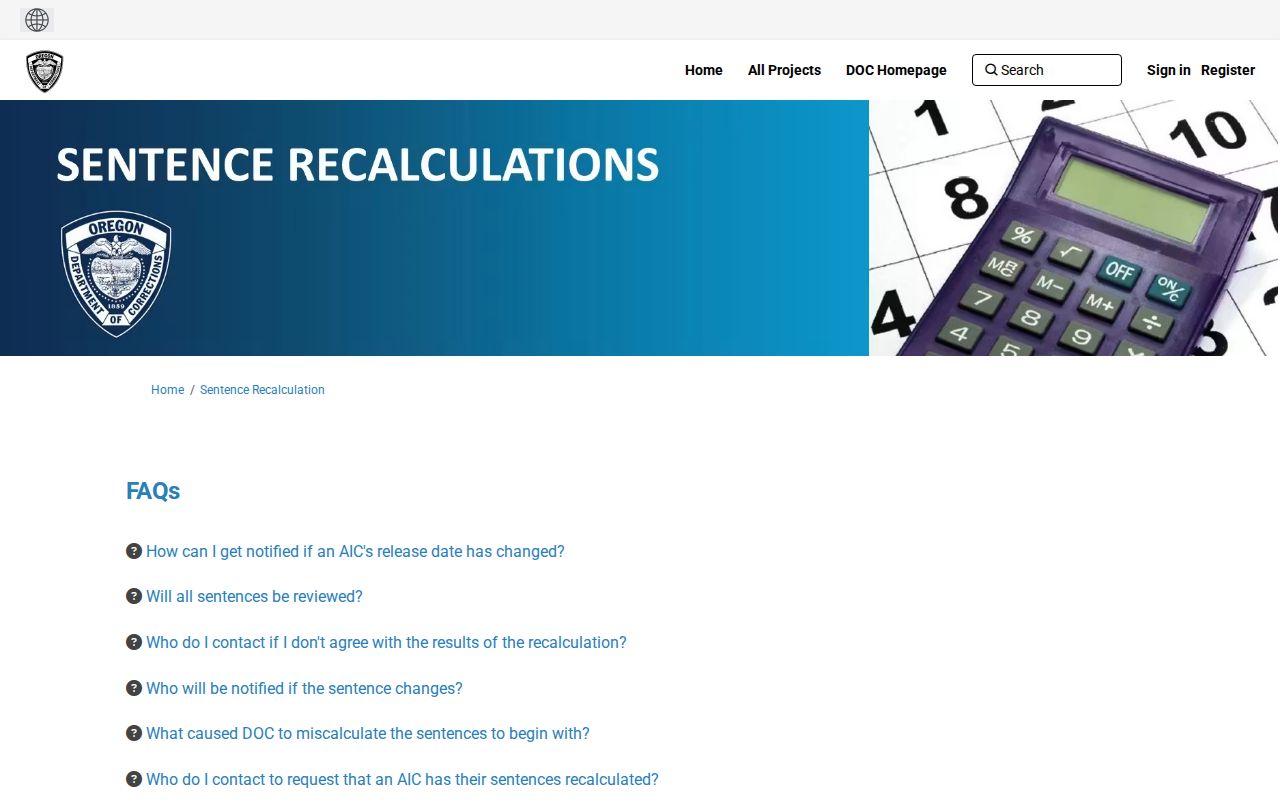
The FAQ also shows why a copied date can become stale. Recheck the live OOS record and use ODOC's sentence-record channel if the calculation appears inconsistent with the judgment.
A court controls its judgment. ODOC applies that judgment through corrections law. An informal request cannot make ODOC rewrite a judgment, so a dispute should include the controlling court document and identify the exact credit or term at issue.
Klamath Clearance Codes Redirect Release
KCSO's charge-level Clearance field is the local bridge between a closed booking and the next system. Public examples show DOC, TRANSPORT, BOND POSTED, ROR, CTS, MATRIX, DISMISSED, DA NO CASE FILED, and mixed outcomes across charges. Reproduce the code exactly. KCSO has not published a full glossary that supports expanding each abbreviation beyond the record.
DOC and TRANSPORT require a receiving-system search. BOND POSTED or ROR points toward community release while the court case and release agreement continue. CTS or an End Of Sentence Date should be compared with the judgment and any other holds. DISMISSED or DA NO CASE FILED concerns a charge outcome, but the court or prosecutor record should confirm the legal result.
One booking can contain several charges with different clearances. Reading only the page-wide “RELEASED as of” heading can miss a transfer or another unresolved path. Check every charge, the actual Released field, and the destination named in the formal record.
Confirm Klamath Physical Release
For a county jail event, ask KCSO for the booking and release record, actual release date and time, disposition or reason, and destination agency if transferred. Compare it with the Klamath Circuit Court judgment or release agreement. The Web Jail Viewer is useful, but no fixed refresh interval or retention period is published.
For ODOC, request public records when formal proof is needed. A Pen Pack may include public-information prints, face sheets, court or sentence orders, and some discharge or supervision records. OOS remains the fast public lead. VISOR can supply future custody-change alerts through the Klamath County VINELink inmate search.
Short-Term Transitional Leave deserves a final distinction. ORS 421.168 can allow an eligible person with an approved plan to leave the institution before the discharge date for a period of up to 120 days, subject to statutory limits. That person remains under legal custody and conditions. An unresolved detainer can instead send the person to another authority.
A projected date answers when one calculation expects a change. An official release record answers what occurred. Use both when the destination or legal status matters.
Dates guide the search, but records prove the event and destination.
Note: Confirm both departure from the named facility and the person's next legal status; one fact does not prove the other.